Step 4: Promote with gates
Consumers never read conda-staging. What they read is conda-internal, and the only way into it
is promotion, which the registry gates. The gate is a scan policy on the source repository,
created by the bootstrap as conda-release-gate on conda-staging:
max_severity: highandblock_unscanned: true: a package with a High vulnerability, or no completed scan, does not move.- conda predicates:
min_attestation_state: verified, denied license familiesgpl,agpl,lgpl(and the specificGPL-3.0-only,GPL-3.0-or-later,AGPL-3.0-only), andblock_install_scripts: true.
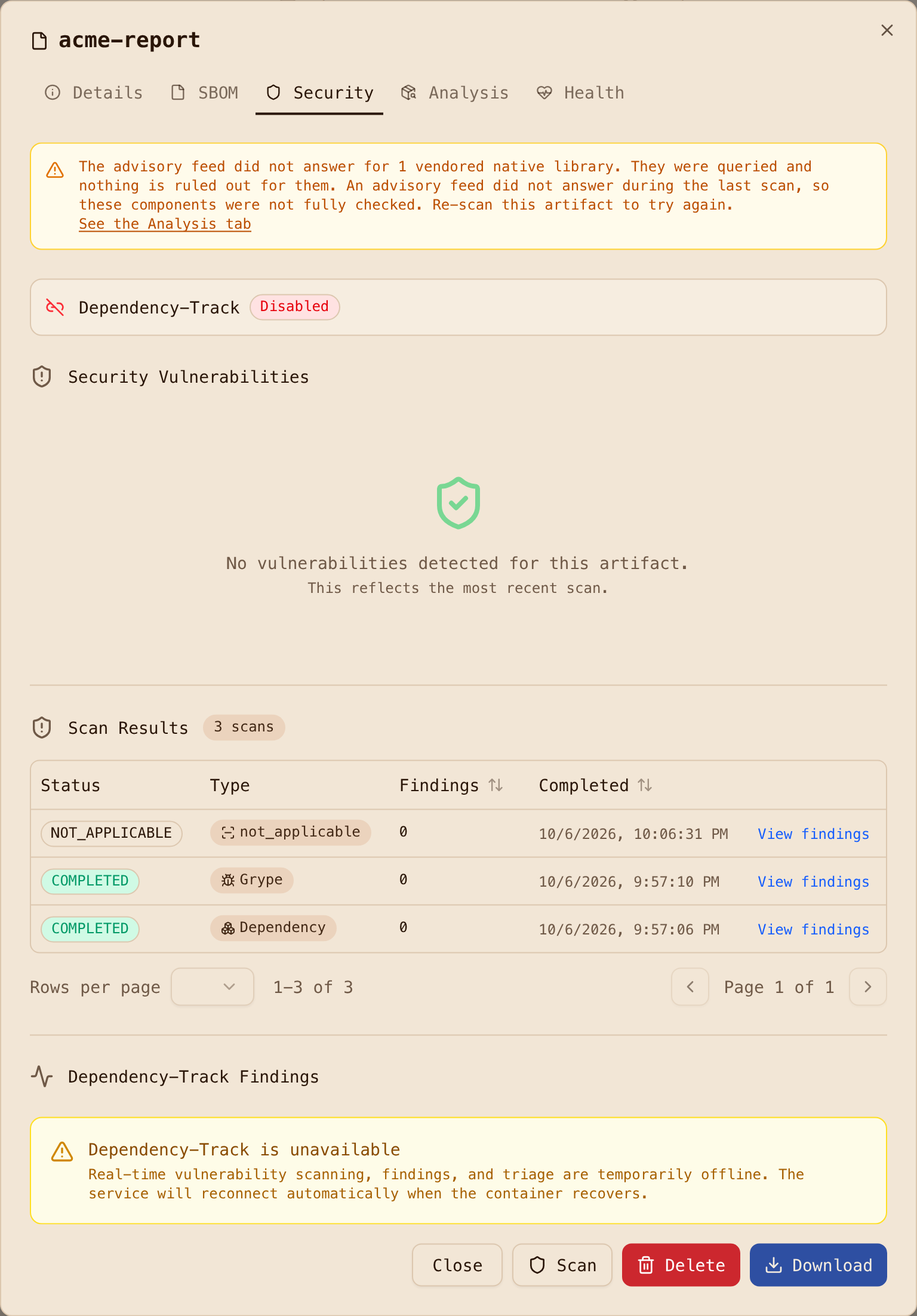
Scan-on-upload is on for both hosted channels, so every package in staging has a Grype result within about 30 seconds of arriving. (Trivy reports conda packages as not applicable; Grype and the registry's dependency scanner do the work.)
What gets refused
Two deliberately bad packages live in
packages/recipes-negative/:
acme-legacy vendors an old urllib3 with seven High CVEs, and acme-copyleft declares
GPL-3.0-only. A third case is a clean package that nobody attested. Promotion answers each with
the rule that stopped it:
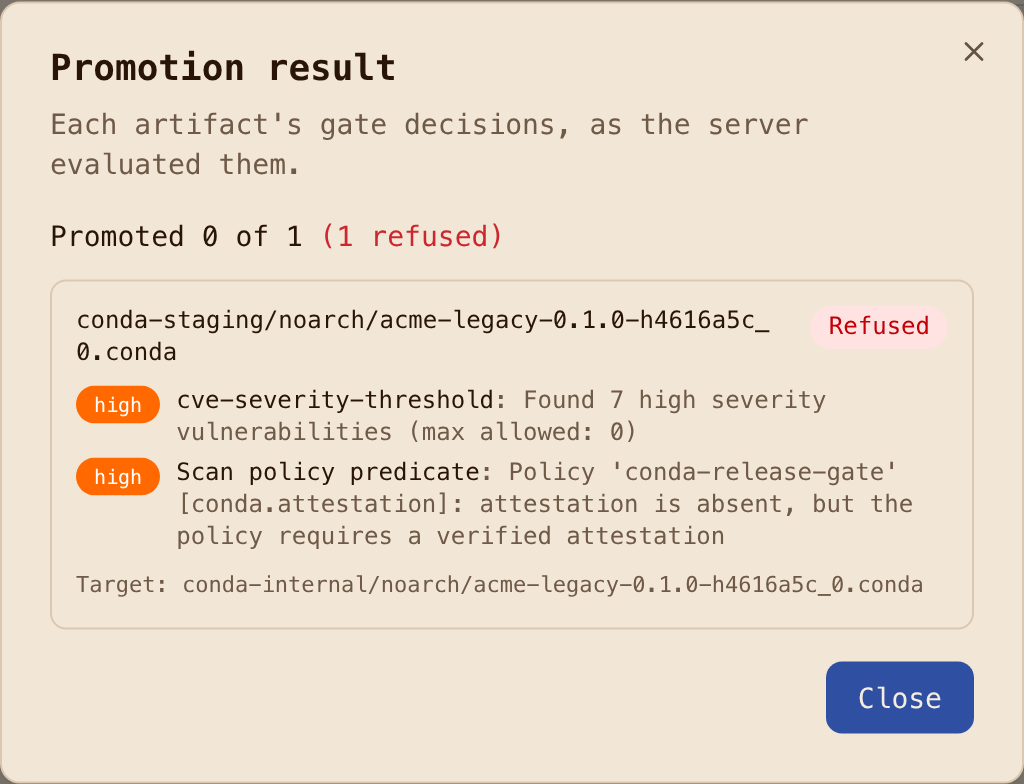
gate cve-severity-threshold: FAILED (Found 7 high severity vulnerabilities (max allowed: 0))
gate policy-predicate:       FAILED (Policy 'conda-release-gate' [conda.license]: declared license 'gpl-3.0-only' is denied;
                                     [conda.license_family]: declared license family 'gpl' is denied)
gate policy-predicate:       FAILED (Policy 'conda-release-gate' [conda.attestation]: attestation is absent,
                                     but the policy requires a verified attestation)
The response carries gate_results, one entry per rule with passed and a reason, so the
decision is auditable and the UI can show it rule by rule rather than as one red toast.
What gets through
The three attested, clean packages promote:
promote: noarch/acme-core-1.0.0-pyh4616a5c_0.conda      -> conda-internal: HTTP 200 promoted=true
promote: linux-64/acme-fastmath-1.0.0-hb0f4dca_0.conda   -> conda-internal: HTTP 200 promoted=true
promote: noarch/acme-report-1.0.0-pyh4616a5c_0.conda    -> conda-internal: HTTP 200 promoted=true
The promoted record in conda-internal keeps everything the solver needs and gains the two
fields the registry adds:
"acme-report-1.0.0-pyh4616a5c_0.conda": {
  "build": "pyh4616a5c_0", "depends": ["python >=3.10", "acme-core >=1.0,<2", "pandas >=2", "rich >=13", "python"],
  "md5": "3d3b34db...", "sha256": "...", "license": "Apache-2.0", "noarch": "python",
  "attestations_sha256": "b5ba0b8a...", "indexed_timestamp": 1791381108494 }
The attestation follows the package: the .sigs sidecar is served from conda-internal with the
same bytes that were verified in staging. Promotion moves rather than copies, so staging lists the
file under removed afterwards.
One detail that matters to an auditor: promotion keeps the package's origin. A package promoted
from staging shows as hosted, originally uploaded to conda-staging by the CI token, and the
promotion itself is in the promotion history with its gate results.