Step 9: Prove it fails safely
A supply-chain story is only as good as its failures. The gates in
gates/
run every one of these on each make gates, against scratch repositories so the demo channels
stay clean.
The dependency-confusion attempt
gates/fake-upstream.sh
builds acme-core 99.0.0, indexes it into a static channel, serves it on the network, and creates
a remote repository pointing at it (the backend only allows that one private address as an
upstream, through AK_SSRF_ALLOW_PRIVATE_CIDRS; without it, a private upstream is refused). A
virtual channel with the internal channel at priority 1 and the fake upstream at priority 2 then
has to choose.
The 99.0.0 is not offered at all, because conda-internal owns the name. Before this rule, the
same test offered ["1.0.0", "99.0.0"] and an unpinned solve picked 99.0.0. The client-side pin
from Step 2 would have held either way; the point is that it no longer has
to.
Overwrite
The same file name with different bytes is refused. Since 1.11.0, a withdrawn name is refused too ("already exists and is immutable"), so the gates mint a fresh version per run.
Tampering and the wrong key
Against a channel of signed packages, the container build's gate:
PASS  signed package
FAIL  flipped byte:            sha256 6248c5a8... != pixi.lock eb370de6...
FAIL  re-locked tampered file: statement does not bind this file
FAIL  wrong key:               accepted signatures do not match threshold, Found: 0, Expected 1
FAIL  unsigned package:        no CEP-50 sidecar
The second case matters: an attacker who can rewrite the lockfile to match a tampered package defeats the hash check, but not the attestation, because the statement binds the original digest.
At the registry, an attestation signed with a key that is not in the trust policy:
trusted key:  HTTP 201
wrong key:    HTTP 400 bundle is signed by key hint wiEcltjl..., which is not a configured trusted key
Offline, and a second mirror
$ pixi install --frozen --offline      # --network none, PIXI_CACHE_DIR pre-filled
 ✔ The default environment has been installed.
The same lock installs from a plain static-directory mirror after changing only [mirrors], and a
package with one flipped byte on that mirror fails:
pixi checks the sha256 in the lock on every install, including when a package is reused from the cache.
A broken member
A virtual channel whose remote member points at a dead upstream:
Not 200 with the member missing. See Step 5 for why.
Withdrawal
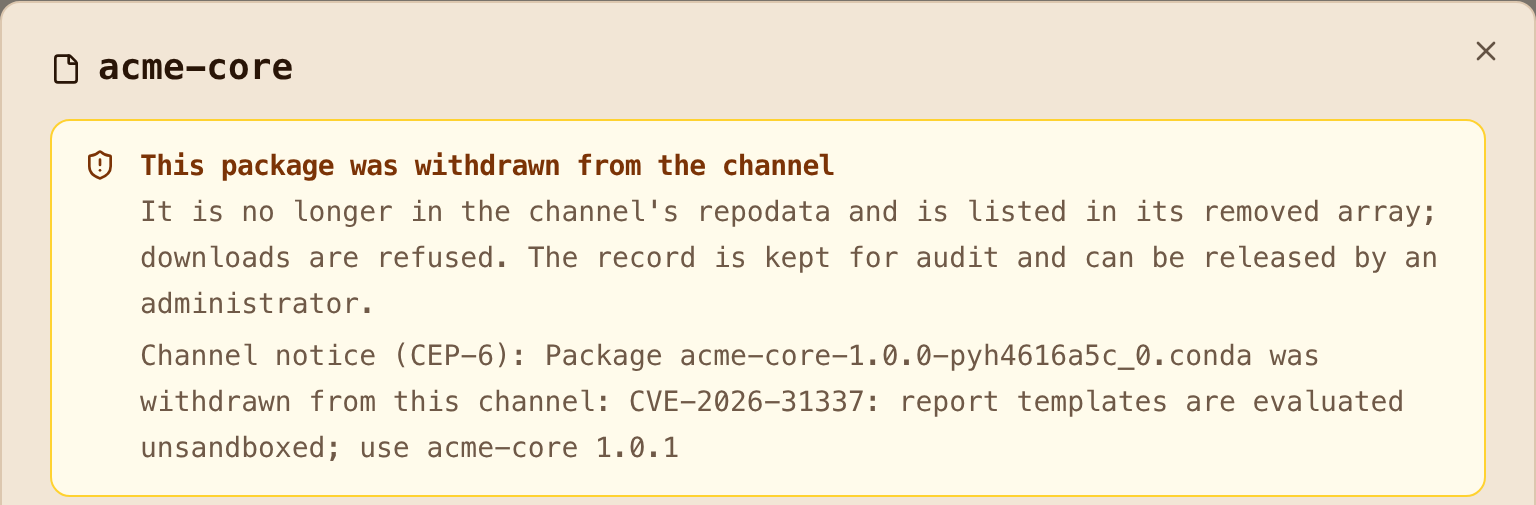
Withdrawing a package from a channel (DELETE /conda/<repo>/<subdir>/<file> with a reason, admin
only) removes it from repodata, lists it under removed, and appends a CEP-6 notice to the
channel's notices.json, which conda clients display. Nothing is overwritten and the history
stays.
Two limitations, stated
exclude-newerin pixi 0.81 filters on the package's own build timestamp, so a backdated package gets past the cooldown. The registry'sindexed_timestampis there for rattler, which uses it; pixi will follow.- Proxy downloads are not yet in the download audit (Step 8).
Now the results.